The 14-year sentence handed to Lami Samuel Dawa has triggered debate over religious freedom, child protection and the court proceedings.
The Borno Christian woman’s 14-year jail sentence has generated widespread debate over religious freedom, child protection and the circumstances surrounding a controversial conviction by a Borno State High Court.
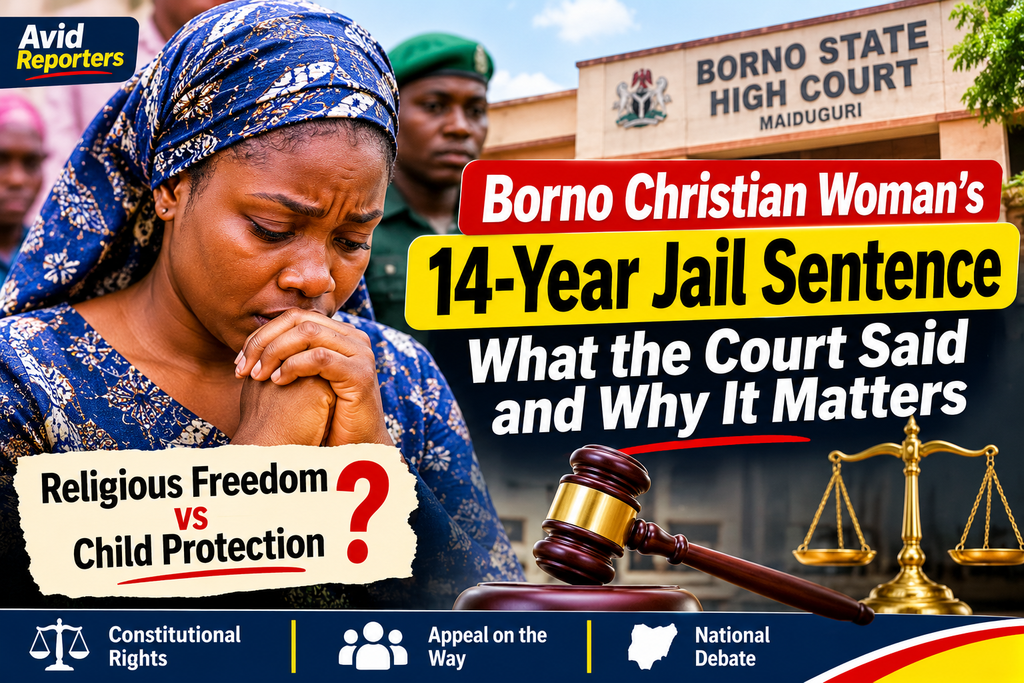
The woman, identified in reports as Lami Samuel Dawa, also referred to as Liyatu Samuel Dawa, was sentenced to 14 years’ imprisonment following a judgment delivered on May 5, 2026, by Justice A. B. Kumdila of the Borno State High Court in Maiduguri.
Initial reports circulated by religious advocacy groups described the conviction as punishment for sharing Christianity with a Muslim woman who allegedly chose to convert voluntarily.
However, details subsequently published by Muslim News Nigeria, citing a certified copy of the court judgment, indicate that the case involved allegations of child abduction, removal from parental custody and interference with a minor’s religious practice.
The emerging details have added another dimension to the controversy, with questions now focusing on the evidence presented during the trial, the application of the relevant laws and the constitutional protection of religious freedom.
What the Court Judgment Reportedly Reveals
According to Muslim News Nigeria, the case, identified as Suit No. BOHC/MG/CR/154/2025, involved six charges against Dawa and four other defendants.
The charges reportedly included conspiracy to abduct a child, enticing a child away from parental custody, abduction and removal from lawful custody, deprivation of education, interference with the child’s religious practice and conversion to Christianity, as well as screening an offender and evidence.
The report states that the prosecution alleged that the defendants were involved in circumstances that led to a girl being moved from her family home in Maiduguri to Christian institutions in Jos.
It further reports that the girl testified that she first converted to Christianity at the age of 13, while she was still a minor.
This account differs significantly from earlier descriptions of the case, which presented the woman at the centre of the controversy as an adult who independently decided to embrace Christianity.
The certified judgment, as reported by Muslim News Nigeria, identifies the defendants as Lami Samuel Dawa, Binta Mamman Sasuwa, Esther Simon, Yusuf Anuwa and Amos Suleiman.
The report says Dawa was convicted, while the other four defendants were discharged and acquitted.
Why Section 210 of the Borno Penal Code Is Central to the Case
One of the provisions attracting attention is Section 210 of the Borno State Penal Code Law, 2023.
The provision concerns enticing a child away from the lawful custody of a parent or guardian.
The prosecution reportedly relied on this provision in one of the charges against Dawa. Other charges were brought under provisions dealing with abduction, child protection, deprivation of education and interference with a child’s religious practice.
The distinction is important because the case cannot accurately be understood as a conviction for religious conversion alone without examining the full charges, evidence and findings of the court.
The central legal questions include whether the prosecution established that the girl was unlawfully removed from parental custody, what role Dawa played in the alleged events and whether the evidence supported the specific offences for which she was convicted.
What Section 38 of Nigeria’s Constitution Says About Religious Freedom
Despite the allegations surrounding the case, the constitutional questions raised by the controversy remain significant.
Section 38(1) of the 1999 Constitution of the Federal Republic of Nigeria guarantees every person freedom of thought, conscience and religion.
The provision includes the right to change one’s religion or belief and to manifest or propagate that religion or belief, individually or collectively, in public or private, through worship, teaching, practice and observance.
This constitutional protection applies to Nigerians regardless of their religious background.
However, freedom of religion does not remove the legal responsibility to respect other people’s rights or protect children from abduction, coercion and unlawful interference with parental custody.
The legal issue, therefore, is whether the prosecution proved the offences charged against Dawa and whether the court properly applied the relevant laws while respecting the constitutional protections available to everyone involved.
Conflicting Accounts Fuel Public Debate
The controversy intensified after international Christian advocacy organisation Barnabas Aid published an account on October 30, 2026, describing Dawa as a Christian woman sentenced for sharing her faith with an adult Muslim woman who voluntarily converted.
The organisation reported that the woman testified that she had not been forced to embrace Christianity.
However, the subsequent report by Muslim News Nigeria, based on its account of the certified judgment, says the person involved was a minor when she first converted and that the prosecution’s case included allegations of abduction and interference with parental custody.
These accounts present different descriptions of the circumstances surrounding the conviction.
Consequently, the case should not be reduced to a simple claim that Dawa was jailed solely for evangelism, nor should the allegations against her be treated as proof of wrongdoing beyond what the court established.
The complete judgment and the evidence presented during the proceedings remain important to a full understanding of the case.
Appeal and Questions About the Conviction
The Christian Lawyers Fellowship of Nigeria (CLASFON), whose members reportedly represented the defendants during the proceedings, has also raised concerns about public descriptions of the case.
According to a report by Law and Society Magazine, CLASFON’s Maiduguri branch chairman, Ephraim Yidawi, said the prosecution involved multiple allegations, including child abduction and interference with the minor’s religious practice.
The organisation reportedly confirmed it had initiated an appeal.
The appeal will allow a higher court to examine the relevant legal arguments, the evidence, and the trial court’s interpretation of the applicable laws.
Among the issues requiring attention are the specific findings against Dawa, the application of the Borno State Penal Code and Child Protection Law, and the relationship between the alleged conduct and the constitutional guarantee of religious freedom.
ALSO READ: Nigerian Bank USSD Emergency Codes: How to Block Your Account If Your Phone Is Stolen
Why the Case Matters
The case has implications beyond the individuals involved.
It raises questions about how Nigerian courts balance parental rights, child protection, religious freedom and the responsibilities of individuals and religious organisations.
It also highlights the importance of accurate reporting of court proceedings, particularly in cases involving sensitive religious and constitutional issues.
For now, the emerging details suggest that the conviction involved more than the religious conversion narrative initially circulated online.
The appeal and closer examination of the certified judgment will be important in determining whether the conviction and sentence can withstand further judicial scrutiny.
Avid Reporters will continue to follow developments in the case as further verified information becomes available.
About the Author