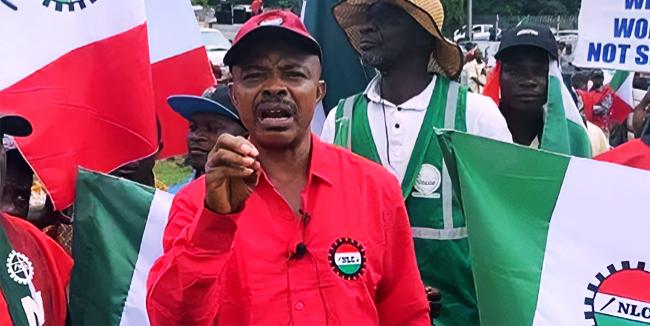
NLC President Joe Ajaero. The labour union has issued the Federal Government a two-week ultimatum.
Labour demands petrol price rollback, fresh minimum wage talks, tax relief and implementation of outstanding agreements with health and public sector workers
By Avid Reporters
NLC ultimatum — The Nigeria Labour Congress (NLC) has given the Federal Government a two-week ultimatum to reduce the price of petrol, commence renegotiation of the national minimum wage and address other outstanding demands affecting Nigerian workers.
The deadline takes effect from Friday, October 9, 2026, meaning the Federal Government has until about October 23 to respond to the demands outlined by the labour centre.
The ultimatum was contained in a communiqué issued after a joint meeting of the NLC’s National Executive Council (NEC) and Central Working Committee (CWC) at Labour House, Abuja, and signed by NLC President, Joe Ajaero.
The Congress directed its affiliates and what it described as progressive allies to remain on high alert and prepared for further action if the Federal Government fails to meet the demands within the stipulated period.
The development comes amid renewed labour concerns over the rising cost of living, declining purchasing power and the impact of petrol prices on transportation and household expenses.
NLC Demands New Minimum Wage Negotiations
The NLC said the purchasing power of the current national minimum wage has been significantly weakened by naira depreciation and rising living costs.
According to the Congress, workers are increasingly struggling to meet basic expenses, including food, housing, healthcare, transportation and education.
It therefore demanded that the Federal Government commence negotiations for a new national minimum wage before the end of October.
The labour centre said the objective should be a living wage that reflects prevailing economic realities and protects the dignity of Nigerian workers.
“The current national minimum wage has been rendered worthless by the relentless depreciation of the naira and the astronomical rise in the cost of living,” the Congress said.
The NLC’s latest demand follows its earlier calls for a review of workers’ earnings as the cost of essential goods and services continues to put pressure on household incomes.
Labour Wants Petrol Price Reduced to 2024 Level
The Congress also renewed its demand for an immediate reduction in the pump price of Premium Motor Spirit (PMS), popularly known as petrol.
The NLC wants the Federal Government to take measures to reduce petrol prices nationwide to the level that prevailed when the current national minimum wage was signed into law in 2024.
The labour body argued that the high cost of petrol has a cascading impact on transportation, food prices and other essential commodities.
It said reducing the price would help cushion the economic pressure on workers and other Nigerians.
The NLC also demanded tax relief for workers and the immediate provision of wage awards to cushion the effects of rising living costs.
Other Demands
Beyond petrol and the minimum wage, the NLC gave the Federal Government additional conditions to address within the two-week window.
They include:
- Implementation of the Terms of Settlement reached with the Joint Health Sector Unions and Assembly of Healthcare Professionals (JOHESU) on February 5, 2026.
- Resolution of other outstanding demands arising from the health-sector agreement.
- Implementation of the demands of the Joint Public Sector Negotiating Council (JPSNC).
- Measures to provide relief to workers facing rising living costs.
The Congress described these measures as necessary to ease the economic burden on Nigerian workers and restore purchasing power.
ALSO READ: FCT Schools Shut as NLC Begins Indefinite Strike Over Teachers’ Promotion Dispute
NLC Warns of Further Action
The labour centre warned that failure by the Federal Government to meet the demands within the stipulated period could lead to further action.
The NLC said it would be compelled to take what it described as “remedial steps” as directed by its relevant organs if the government fails to act.
It also called on its affiliates and allies to remain prepared for what it described as “decisive efforts” against policies it considers detrimental to workers and the wider population.
The Congress said its decisions followed deliberations on the economic and social pressures confronting workers and Nigerians generally.
It cited inflation, naira depreciation, declining wages in real terms and the rising cost of living as major concerns.
The latest ultimatum therefore places renewed pressure on the Federal Government to engage organised labour before the deadline expires on October 23, 2026.
Avid Reporters
About the Author