
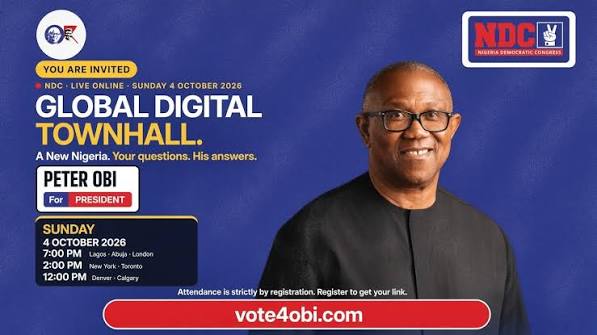
Peter Obi's Vote4Obi campaign platform combines voter mobilisation, state-level messaging and vote-protection tools ahead of the 2027 election.
By Avid Reporters
Peter Obi campaign website, Vote4Obi.com, has emerged as a central digital platform for the presidential campaign of the Nigeria Democratic Congress (NDC) ahead of the 2027 general election, combining campaign messaging, voter mobilisation, election-monitoring plans and a state-by-state policy vision in one interactive platform.
The website, vote4obi.com, places Peter Obi and former Kano State governor Rabiu Musa Kwankwaso at the centre of what the campaign describes as the “OK ticket,” with Obi presented as presidential candidate and Kwankwaso as vice-presidential candidate.
Rather than functioning solely as a conventional campaign website, the platform is designed to move visitors from consuming campaign information to taking specific actions, including mobilising voters, participating in voter protection efforts, accessing campaign materials and exploring proposed priorities for individual states.
From ‘12 Years of APC’ to a vision for every state
One of the website’s most prominent features is its #AVisionForYourState campaign.
The section invites users to select their state and explore what the campaign describes as a transition “from consumption to production” at the state level.
The platform says its proposed approach would focus on producing more of what Nigerians consume, reducing waste, improving revenue generation and expanding access to power for productive activity.
It presents the state-level vision as an extension of the NDC’s broader policy framework, titled “The Nigeria You Deserve.”
The website’s message is deliberately localised: instead of presenting a single national manifesto alone, it asks Nigerians to examine what the campaign’s proposed economic direction could mean “where you live.”
That approach could make the platform particularly relevant to voters interested in how a presidential campaign intends to connect national policy with issues affecting their individual states.
READ ALSO: Abductors Demand ₦950m Ransom for 19 NYSC-Bound Graduates in Imo
Campaign turns its attention to APC’s 12-year record
Another major section is titled #12YearsOfAPC, where the campaign presents a lengthy assessment of what it describes as the consequences of APC-led federal government since 2015.
The website says the section is based on a 125-page report examining what the APC inherited in 2015, what it promised and what Nigerians are experiencing in 2026.
The campaign focuses on issues including household purchasing power, food prices, fuel and electricity, insecurity, education, governance and electoral participation.
It also provides interactive features allowing visitors to explore the campaign’s arguments through their personal circumstances, including income, age and prices of selected goods.
The material is explicitly presented from the perspective of the Obi campaign and should therefore be understood as campaign advocacy and political messaging, rather than an independent government performance audit.
Website speaks directly to different groups
Another striking feature of Vote4Obi.com is its effort to tailor campaign communication to different categories of Nigerians.
The platform contains dedicated messages addressed to APC supporters, INEC officials, police officers, agberos, the middle class, young people, the #EndSARS generation, Obidients and Nigerians who have given up on the political process.
That structure suggests an attempt to move beyond preaching primarily to existing supporters and instead address different groups that could influence the 2027 election.
The campaign also provides WhatsApp materials, memes, posters, profile pictures, photographs and other downloadable content intended for supporters to share online and offline.
‘20 voters’ becomes a central mobilisation strategy
Perhaps the most operational component of the platform is its voter-mobilisation system.
The campaign asks supporters to identify 20 people they intend to bring out to vote, with the website linking users to a dedicated mobilisation platform.
Supporters can reportedly log voters, track whether they have PVCs and indicate who intends to vote with them.
The campaign’s broader arithmetic is built around the idea of millions of supporters each mobilising 20 additional voters.
The website says its goal is to reach 20 million votes, while also developing a large network of citizen agents to monitor voting and the movement of results from polling units through the collation process.
Vote protection takes centre stage
Vote protection is another major pillar of the website.
Under its “2027 is not 2023” campaign, the platform encourages voters to arrive early, remain at their polling units until counting is completed, observe the process and photograph posted result sheets.
The campaign says it wants citizen agents and voters to follow results through the various stages of collation.
It calculates a requirement of 372,934 citizen agents, based on having two agents at every polling unit, ward, local government, state/FCT and national collation level.
The figure is explicitly identified by the website as the campaign’s own arithmetic based on INEC’s published administrative figures.
The strategy has gained additional prominence following Obi’s October 4 global digital town hall, during which he urged Nigerians to protect their votes and remain at polling units until ballots were counted.
ALSO READ: Kalu Kalu Challenges Otti: Show One Project in Ohafia, I’ll Quit 2027 Governorship Race
Website connects online mobilisation with grassroots politics
The platform also attempts to bring together several political movements behind Obi and Kwankwaso.
Its #United4OK section features movements including the Obidient Movement and Kwankwasiyya, among others, while calling on different groups to coordinate rather than operate independently.
The campaign says the objective is to create a common mobilisation structure covering polling units across the country.
The website consequently functions not merely as an information portal but as a digital organising infrastructure for the campaign.
A campaign website built around interaction
Beyond conventional campaign speeches and policy documents, Vote4Obi.com uses interactive tools, downloadable graphics, personalised exercises and social-media materials to encourage visitors to participate.
The platform is available in English, Pidgin, Yoruba, Igbo and Hausa, broadening its communication approach across linguistic audiences.
It also includes an invitation to a global digital town hall and provides registration access for supporters in Nigeria and the diaspora.
The development comes as political activity ahead of the 2027 presidential election accelerates.
INEC’s revised timetable lists January 16, 2027 for the presidential and National Assembly elections, with the governorship and State House of Assembly elections scheduled for February 6, 2027.
For Obi’s campaign, the new website therefore represents an attempt to combine message, mobilisation, voter education, grassroots organisation and election-day monitoring within a single digital ecosystem.
Whether the platform can translate its online reach into the millions of physical voters, polling-unit structures and election-day presence envisioned by the campaign will ultimately be tested beyond the website itself.
For now, however, Vote4Obi.com signals a more structured digital approach to Obi’s 2027 campaign—one that seeks to turn online supporters into organised participants at the polling-unit level.
Avid Reporters — Stay In the Know.
About the Author